Cold outreach is a deliberate choice with real tradeoffs for an advisory firm. If you use it, lead with relevance instead of a pitch: research each prospect enough to have a genuine reason to reach out, keep messages short with one clear ask, treat LinkedIn as a slow relationship channel, segment before you send, and run a follow-up cadence with a defined end. This guide covers that approach and when cold is the wrong tool.
Key Takeaways
- Lead with relevance and research instead of a pitch about yourself; before sending, check that you have a genuine reason to contact this specific person and that the channel and timing respect their preferences and any consent expectations.
- Centers of influence, the accountants and attorneys who already serve your ideal clients, are one candidate audience; look for a genuine connection or specific reason before reaching out.
- If you contact business owners, segment by industry, size, or the decision you can help with so the message speaks to their specific situation instead of treating them as a group.
- Keep voicemails and emails short with a single clear ask, and use a spaced follow-up cadence that adds something useful each time and has a defined end.
- Skip cold outreach when you have warmer options, have not done the research, or would need pressure or misrepresentation to make it work; run scripts and templates through your firm's review process.
Lead With Research, Not A Pitch
The single biggest upgrade you can make is to stop leading with yourself. The old model opened with a pitch. Who you are, what you do, why they should meet you. Nobody wants that from a stranger, and in a world where everyone is drowning in messages, a self-focused opener gets deleted before the second sentence.
The modern version opens with relevance. Before you contact anyone, you do enough research to understand their situation and have a genuine reason to reach out. Not personal snooping, but professional context. What does this person do. What kind of situations do people in their position tend to face. Is there a specific reason your expertise would matter to them right now. When you can answer those questions before you reach out, your message stops being an interruption and starts being useful.
When your first message shows that you understand their world, it changes the entire dynamic. You are no longer a random advisor interrupting their day. You are someone who took the time to be relevant. That earns a reply far more often than any clever hook. Consider a generic contrast. One message says, "I am a financial advisor and I would love to grab fifteen minutes to introduce myself." Another says, "I work with people navigating the sale of a business, and the tax and cash-flow decisions in that window tend to catch owners off guard. If that is on your horizon, I am happy to share what usually trips people up." The second one respects the reader and gives them a reason to answer.
Research also protects you from wasting effort. When you actually look before you reach out, you naturally filter out people who are not a fit. You send fewer messages to better prospects, and your results improve on both ends. The old model treated volume as the strategy: send enough messages and someone will bite. The modern model treats relevance as the strategy: send fewer, better messages to people for whom you genuinely have something to offer. That shift is the whole game, and everything else in this guide flows from it.
Build Relationships With Centers Of Influence
The warmest form of cold outreach is not really cold at all. It is reaching out to professionals who serve the same clients you want to serve. Accountants, attorneys, and other specialists sit next to your ideal clients every day. When they trust you, they send people your way, and a referral from a trusted professional arrives pre-warmed in a way no direct outreach can match.
This kind of outreach works because it is built on mutual benefit. You are not asking a stranger to hand over their financial life. You are asking a fellow professional whether it makes sense to know each other. That is a normal, low pressure conversation between peers, and most professionals are open to it because their clients occasionally need exactly what you do. An attorney handling estate work, an accountant with clients facing a liquidity event, a specialist whose clients keep asking questions outside their lane: each of them benefits from having a trustworthy advisor to point to.
Approach it that way. Reach out with genuine curiosity about their practice and a clear sense of how you might help each other's clients. Offer value before you ask for anything. Share something useful, make an introduction, or simply be the kind of advisor they would feel comfortable sending someone to. The professionals who build strong referral networks are almost always the ones who give first. They send business, they solve problems, and they make the other professional look good to their own clients. That generosity comes back.
These relationships take time, and that is the point. A center of influence relationship built patiently can send you qualified clients for years. It is one of the highest return uses of cold outreach precisely because it compounds instead of resetting every time. One good relationship with a busy accountant can be worth more than hundreds of cold messages to individuals, because the accountant does the qualifying and the warming for you. Treat these relationships as long-term investments, not transactions. Stay in touch, keep giving, and do not disappear the moment a referral does not materialize on your timeline. The advisors who win here play a patient game.
Target Business Owners Deliberately
Business owners are a natural fit for direct outreach because their financial lives are complex and often underserved. They face decisions that generic advice does not address, and many of them know they need help but have not found the right person. Their business and personal finances are tangled together, their income is lumpy, and the big moments in their financial lives (raising capital, buying out a partner, selling the company) are exactly the moments where good advice pays for itself many times over.
The key is to be specific about who you are reaching and why. A business owner in a particular industry or at a particular stage faces recognizable challenges. When your outreach speaks to those challenges, it lands as relevant rather than random. A message that names the specific decision an owner is likely wrestling with will always beat a generic offer to help with their finances, because it proves you understand their world before you ever ask for their time.
Do not treat business owners as a monolith. The questions facing someone building a company are different from the questions facing someone preparing to sell one. An owner in growth mode is thinking about reinvestment, cash flow, and personal risk. An owner heading toward an exit is thinking about valuation, taxes on a sale, and what life looks like after. The more precisely you understand the situation, the more your outreach reads as insight rather than a pitch. That precision is what separates a message worth answering from one worth deleting. Segment by industry, by size, by stage, or by the specific event you can help with, and tailor accordingly.
Respect their time. Business owners are busy and skeptical of anyone selling. They get pitched constantly, and their filter for salespeople is finely tuned. Lead with something useful, keep it short, and make the next step easy. If you have earned a conversation, they will take it. If you have not, no amount of persistence will fix a message that never gave them a reason to care. The owners worth reaching are exactly the ones who will not tolerate a lazy pitch, so the bar for relevance is high, and clearing it is the whole job.
Structure Voicemails And Emails To Get Replies
The mechanics matter. Even a well researched outreach fails if the message itself is bloated or unclear. Both voicemails and emails work better when they are short, specific, and easy to respond to. The message is where good research either pays off or gets buried, so it is worth getting the structure right.
For voicemails, keep it brief. Say who you are, give a clear and relevant reason you are calling, and leave a simple next step. Do not pitch. Do not ramble. A long voicemail almost never gets a callback. A short, relevant one occasionally does, and that is enough. Speak like a person, not a script. A useful shape is about fifteen seconds: your name and firm, one sentence on why you specifically are reaching out to them, and one clear line about what happens next. If you find yourself explaining your services in a voicemail, you have already lost the listener. The goal of the voicemail is a callback or a warm reception to your follow-up, not a sale.
For email, the subject line carries a lot of weight. Make it honest and specific, not clickbait. A subject line that overpromises or tricks the reader into opening does more harm than good, because the moment they feel manipulated, you are done. In the body, get to the point fast. Establish relevance in the first line, offer something of value, and end with a single clear ask. One question is easier to answer than three. Keep the whole thing skimmable, because that is how it will be read. Short paragraphs, no jargon, and a single obvious next step. If a busy person can grasp your point in five seconds of skimming, you have a chance. If they have to work to understand what you want, they will not.
Follow up matters more than any single message. Most replies come after the first contact, not on it. A short, polite sequence of touches over a reasonable period will almost always outperform a single perfect message. But follow up is not the same as nagging. Add a little value each time and stop when it is clear there is no interest. A good follow-up gives the reader a new reason to respond rather than simply repeating "just checking in." Share a relevant thought, a useful resource, or a fresh angle on why you reached out. And know when to stop. Persistence past the point of interest reads as desperation and costs you the goodwill you were trying to build.
Use LinkedIn Without Being A Pest
LinkedIn is the one channel where the line between smart outreach and spam is thinnest, because the platform makes it so easy to blast strangers. The advisors who use it well treat it as a slow relationship channel, not a lead machine. The ones who use it badly send a connection request and a pitch in the same breath, which is the digital equivalent of introducing yourself and asking for a meeting in the same sentence.
Start by making your own profile worth looking at. When you reach out, the first thing a thoughtful prospect does is check who you are. A profile that clearly communicates who you help and how, without reading like a sales page, does quiet work for you before you ever send a message. If your profile is thin or salesy, even a good message will land poorly.
Connect for real reasons and let the relationship develop before you ask for anything. A connection request with a short, genuine note about why you are reaching out works far better than a blank request followed by a pitch. Once connected, engage like a person. Comment thoughtfully on things the other person shares, offer a useful perspective, and be visible in a way that adds value rather than always selling. Over time, that presence earns the kind of familiarity that makes a direct conversation feel natural. LinkedIn rewards patience and punishes the hard sell, so treat it as a place to be known and trusted, not a place to close.
Sharing useful content of your own, within whatever your compliance process allows, quietly supports all of this. When the people you want to reach see you offering genuine insight over time, your eventual outreach arrives with context. They already have a sense of who you are, which turns a cold message into a warm one. That is the whole aim: to make your outreach feel like a natural next step rather than an interruption from a stranger.
Segment Before You Send
One list treated as one audience is a recipe for generic messaging, and generic is the death of cold outreach. Segmentation is what lets you be specific at scale. Instead of sending one message to everyone, you group people by what they have in common and speak to each group in its own language.
The dimensions that matter depend on who you serve. You might segment by profession, so your message to attorneys differs from your message to accountants. You might segment business owners by industry or stage, so a message to a founder in growth mode differs from a message to an owner nearing an exit. You might segment by the specific situation you can help with, so people facing a particular decision hear about that decision rather than your services in general. The point is to make each message feel written for the reader, because in effect it was.
Segmentation also makes your effort measurable and improvable. When you send different messaging to different groups, you can see which segments respond and which fall flat. That tells you where to spend your time. Maybe one profession replies at several times the rate of another, or one industry of business owners is far more receptive than you assumed. Without segmentation, all of that signal blends into a single muddy number and you learn nothing. With it, every round of outreach teaches you something you can use in the next.
Keep the segments simple enough to actually maintain. You do not need dozens of tiny groups. A handful of well-defined segments, each with messaging that speaks to its situation, is far more useful than an elaborate scheme you never keep current. Start with the two or three groups that matter most to your firm and build from there.
Build A Follow-Up Cadence That Respects People
Most of the value in cold outreach lives in the follow-up, and most advisors quit long before that value shows up. A single message is easy to ignore, and even interested people are busy and forget. A thoughtful cadence keeps you present without becoming a nuisance, and it is often the difference between outreach that works and outreach that fizzles.
A workable cadence spaces a small number of touches over a reasonable period, with each touch adding something rather than simply repeating the last. The first message establishes relevance and makes an easy ask. A follow-up a few days later might offer a useful resource or a different angle. A later touch might share a relevant observation or simply check whether the timing is better now. The spacing matters as much as the content: too close together feels like pressure, too far apart loses the thread. The exact rhythm depends on your audience, but the principle holds across all of them.
Vary the channel where it makes sense. A prospect who ignores email might respond to a short voicemail, and someone who did not answer a call might reply to a thoughtful LinkedIn note. Using more than one channel, without hammering any single one, gives your message more chances to land at a moment when the person actually has time to consider it. Just keep the tone consistent and the total volume reasonable, so it feels like a professional reaching out rather than a system grinding away.
Then know when to stop. This is the part most people get wrong in both directions. Some quit after one message and leave most of the potential replies on the table. Others keep going long past the point of interest and turn a neutral impression into a negative one. A defined cadence with a defined end solves both problems. You commit to a reasonable sequence, you add value along the way, and when it is clear there is no interest, you stop gracefully and move on. The prospect who was not ready this quarter may remember you well enough to reach out later, precisely because you were professional about backing off.
Know When Cold Is The Wrong Move
Cold outreach is a tool, not a strategy for every situation. There are times when it is simply the wrong approach, and recognizing them will save you a lot of wasted effort and reputation damage. The advisors who get the most from cold outreach are also the ones who know when not to use it.
Cold outreach is a bad idea when you have not done the research. Contacting people at random, with generic messages, at high volume, is the old broken model. It rarely works and it damages how you are perceived. If you are not willing to do the work of understanding who you are reaching and why, you are better off not reaching out at all, because scattershot outreach makes you look exactly like the pushy broker everyone learned to avoid.
It is also a poor fit when you have warmer options available. If you have referrals, existing relationships, or an audience you have built through content, those channels will almost always outperform cold contact. A referral arrives with trust already attached. A content audience already knows your thinking. Cold outreach starts from zero, so it makes the most sense when you are entering a new market or reaching a specific group you cannot access any other way. Before you invest heavily in cold, make sure you have exhausted the warmer channels sitting right in front of you.
And it is the wrong move whenever it would cross a line into pressure or misrepresentation. Anything that overpromises, creates false urgency, or misstates your role is not just ineffective. It is a compliance problem, and it can cost you far more than a few missed conversations. Keep your outreach honest, appropriate, and reviewed by whatever process your firm uses. Have your scripts, templates, and any advertising cleared before you use them, and stay within what your compliance resource approves. The goal is to open a respectful conversation, never to corner someone. If a tactic only works because it pressures or misleads, it is not a tactic worth using.
Make It A System, Not A Scramble
The advisors who succeed with cold outreach treat it as a repeatable process rather than a burst of activity when things get slow. They define who they are trying to reach, they build a research routine, they use consistent messaging that has cleared review, they segment their list, they follow a disciplined cadence, and they track what happens. Each of those pieces reinforces the others, and together they turn a dreaded chore into a channel that produces.
That system is what turns cold outreach from a chore into a channel. Instead of dreading it, you refine it. You learn which segments respond, which messages land, and where your time is best spent. Over months, that discipline produces a steady flow of conversations rather than an occasional lucky hit. The work stops feeling like gambling and starts feeling like operating a machine you understand and can tune.
It also keeps you sane. Cold outreach involves a lot of non responses, and taking each one personally is a fast road to burnout. When you have a system and reasonable expectations, that does not discourage you. You know the numbers, you focus on quality, and you keep the machine running. The advisor who expects every message to land will quit in a month. The advisor who understands that a small percentage of good outreach turns into good conversations will keep going and will win.
Bringing It Together
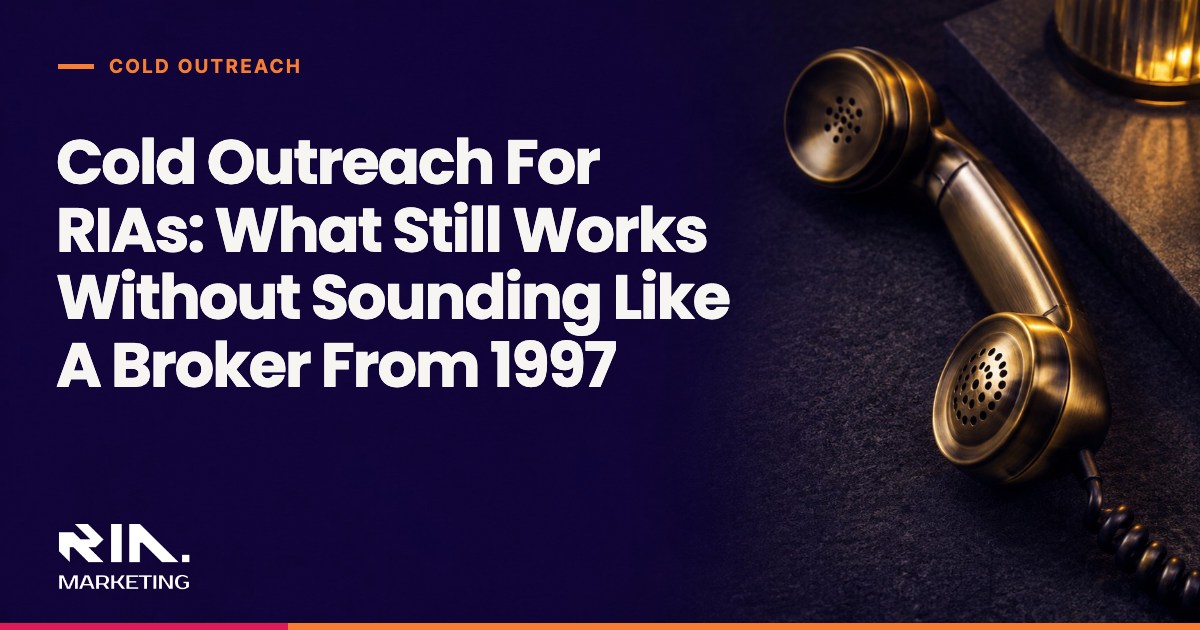
Cold outreach is not about dialing until someone gives in. It is about being genuinely relevant to the right people, opening a real conversation, and following up with respect. The broker-from-1997 approach failed because it treated people as targets, hammered them with volume, and led with a pitch nobody asked for. The modern approach works because it treats people as professionals who deserve a reason to talk, and because it does the quiet work of research, relevance, and patience.
Lead with research. Build relationships with the professionals who already serve your ideal clients. Reach out to business owners with specificity about their real situation. Keep your messages short and human. Use LinkedIn as a slow relationship channel, not a pitch machine. Segment before you send, follow up with a cadence that respects people, and know when cold is simply the wrong tool for the moment. Run all of it through your firm's review process, and you have an approach that grows your firm without costing you your reputation.
Let's Build Your Outreach Engine
If cold outreach has felt uncomfortable or unproductive, the problem is usually the system, not the channel. The right targeting, the right messaging, and a follow up process that clears your review can turn it into a reliable source of qualified conversations rather than a source of dread.
That is exactly the kind of growth system we help RIAs design and run. If you want cold outreach that opens doors instead of closing them, talk with RIA.marketing about building an advisor marketing system tuned to your firm. We will help you build an approach that fits your practice, respects your prospects, clears your compliance process, and produces the conversations you actually want.
Related RIA Marketing Guides
Ready to turn marketing into a system?
Connect with our team at RIA.Marketing. We help advisory firms build practical, compliance-conscious systems for visibility, follow-up, and qualified inquiries.
Schedule Your Private Strategy Session